zxplay_go
A faithful emulator for the entire Sinclair 8-bit line — the ZX80, the ZX81, every classic ZX Spectrum (48K, 128K, +2, +2A, +3), the Pentagon clone, and a from-the-silicon-up ZX Spectrum Next — written in Go.
zxplay_go is a fork of zx_go by Conor Armstrong; see LICENSE for the licensing of the combined tree.




| Cybernoid (+3) | NextZXOS welcome | NextZXOS menu |
|---|---|---|
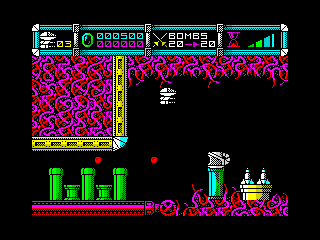 | 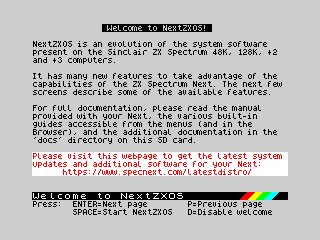 | 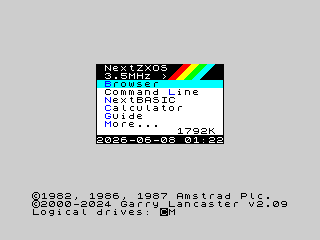 |
| Sonic the Hedgehog (Next) | Warhawk (Next) |
|---|---|
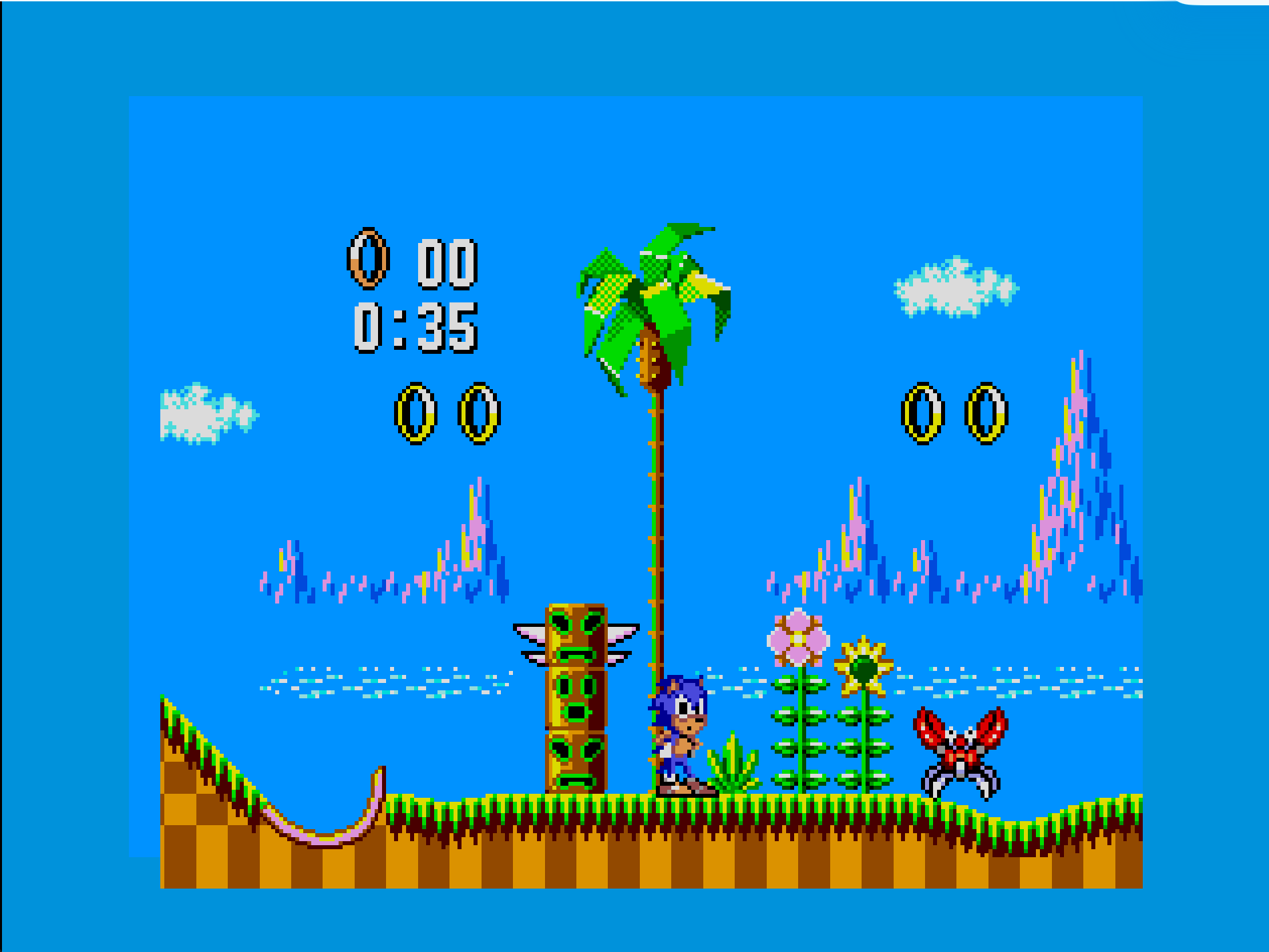 | 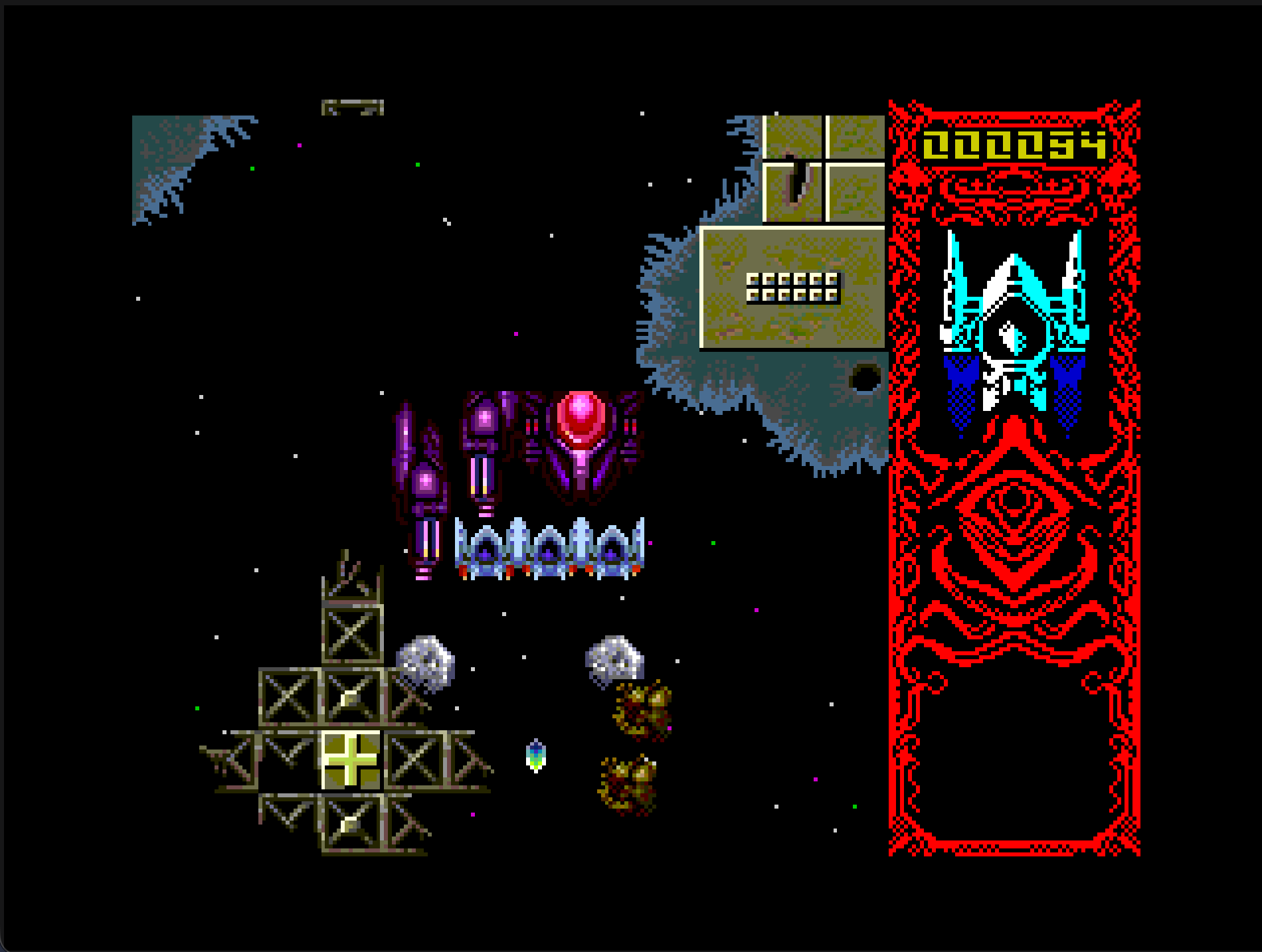 |
zxplay_go runs the whole family on one codebase, from the 1980 ZX80 to the 2017 Spectrum Next. Classic models are cycle-accurate with full memory and port contention; the Spectrum Next cold-boots real NextZXOS through the authentic FPGA boot chain — no snapshots, no shortcuts — to a fully interactive desktop, with a deep custom-hardware stack emulated.
The 48K was the original author's first computer; this began as a Go learning exercise and turned into a serious emulator.
Honest status
• Classic line (ZX80 → +3, Pentagon, SAM Coupé): mature and stable. Cycle-accurate Z80 (passes both Cringle
zexdoc/zexallexercisers), full contention, every documented format. These are the solid, day-to-day-usable part of zxplay_go.• Spectrum Next: faithful boot, young game compatibility. NextZXOS cold-boots end-to-end and the individual hardware blocks are extensively tested against the FPGA VHDL, but running arbitrary
.NEXgames is the newest and least-finished area. A growing set of titles are playable (e.g. Sonic), several render but still have bugs, and many have not been verified at all. If a Next game misbehaves for you, that's expected at this stage — please open an issue; a comparison against real hardware is exactly what moves it forward.The per-title manifest, with tested-on-hardware statuses and known issues, is in docs/compatibility.md. Feature claims below describe implemented and tested hardware blocks; they are not a promise that every title exercising them runs perfectly.
Highlights
- 🖥️ The whole family, one emulator — ZX80 · ZX81 · Spectrum 48K · 128K · +2 · +2A · +3 · Pentagon 128 · Spectrum Next · SAM Coupé.
- ⚡ The Next, done properly — authentic cold boot to NextZXOS, Layer 2 (incl. 320×256 / 640×256 hi-res), 128 hardware sprites with collision, tilemap, Copper, the full NextReg file, 8K MMU, DivMMC/esxDOS, Turbosound, DACs, RTC, and all four clocks up to 28 MHz.
- 💾 Every common format — snapshots (
.sna/.z80/.szx), tapes (.tap/.tzx), six disk formats, TR-DOS.trd, microdrive.mdr,.NEX, and RZX recordings. - 🎛️ Period-accurate peripherals — +3 FDC, Beta Disk, Interface 1 & 2, DISCiPLE, Multiface 1/128/3, Kempston mouse, ZX Printer, every joystick scheme.
- 🔊 Real sound — ULA beeper, AY-3-8912 / Turbosound, SpecDrum & Covox DACs, the Next 4-channel DAC, measured AY volume curve.
- 🐞 Three debuggers, one live backend — a visual GUI, a scriptable telnet server, and headless trace instrumentation, all sharing the same breakpoints, watchpoints, and time-travel ring.
Quick start
# Requires Go 1.25+ and a C toolchain (Fyne uses cgo for the OS window layer)
git clone https://github.com/stever/zxcode
cd zxcode/packages/emulator-core/zxplay_go
go build -o bin/zxplay_go ./cmd/zxplay_go
./bin/zxplay_go
Then:
- Snapshot:
File → Open File…and pick a.sna/.z80/.szx— it just runs. - Tape:
File → Open File…, pick a.tap/.tzx, then typeLOAD ""(or pressJ,",", Enter) in 48K BASIC. - Spectrum Next:
Machine → ZX Spectrum Nextand accept the one-time ROM download. See The Spectrum Next.
Prefer not to build? Grab a pre-built binary.
Contents
- Highlights
- Quick start
- Supported machines
- File formats
- Sound & peripherals
- The Spectrum Next
- Installation
- Using zxplay_go
- Debugging & headless tooling
- How it compares
- Documentation
- Project layout
- License
Supported machines
| Machine | Status | Notes |
|---|---|---|
| ZX80 / ZX81 | ✅ Interactive | Faithful CPU-generated display (NOP-on-the-bus video, R-register INT, ZX81 SLOW-mode NMI border), native per-machine keyword keyboard, .P/.O loading. --zx81 / --zx80. |
| Spectrum 48K | ✅ Interactive | The original. Cycle-accurate, contended. Interface 1 microdrive option. |
| Spectrum 128K / +2 | ✅ Interactive | AY sound, 128 KB paged memory, the 128 menu. |
| Spectrum +2A / +3 | ✅ Interactive | $1FFD 4-ROM paging; the +3 adds the integrated μPD765A FDC and disks. |
| Pentagon 128 | ✅ Interactive | Soviet clone: 128K + AY, no contention, 71680-T frame, TR-DOS .trd via the Beta Disk interface. --pentagon. |
| ZX Spectrum Next | ✅ Cold-boots NextZXOS | Real FPGA boot chain → NextZXOS desktop; full custom hardware. See below. |
| SAM Coupé | ✅ Interactive | MGT's 1989 Z80B machine: custom ASIC (4 screen modes, 128-colour palette, bordered display), 256/512K paging, SAA1099 sound, WD1772 floppy — real disk games boot (File → Load SAM Disk, then BOOT). Cold-boots the bundled MGT ROM 3.0 to SAM BASIC. --sam. See docs/sam-coupe.md. |
Classic timing is cycle-accurate with memory and port contention; the +3/+2A 4-ROM paging, all tape formats, and all six disk formats are supported. Switch models any time from the Machine menu (state is cold-wiped).
File formats
| Format | Extensions | Load | Save | Notes |
|---|---|---|---|---|
| Snapshots | .sna .z80 .szx | ✓ | ✓ | Full 48K + 128K |
| Tape | .tap .tzx | ✓ | ✓ | TZX save covers blocks 0x10/0x11/0x14 |
| Disk (+3) | .dsk .edsk | ✓ | ✓ | EDSK handles weak sectors |
| Disk (other) | .udi .mgt .img .sad .d40 .d80 | ✓ | — | Full format coverage |
| TR-DOS / Beta | .trd | ✓ | — | Pentagon / 48K / 128K via WD1793 |
| Microdrive | .mdr | ✓ | ✓ | Sinclair cartridge format |
| Interface 2 cartridge | .rom | ✓ | — | 16 KB, 48K-only |
| RZX recordings | .rzx | ✓ | ✓ | Per-frame insn count + IN stream |
| Spectrum Next | .nex | ✓ | — | v1.2 loader: banks, palette, Copper |
| ZX81 / ZX80 program | .p .81 / .o .80 | ✓ | — | Raw dump, loads into ZX8x mode |
| Audio capture | .wav | — | ✓ | Record emulator output |
| Screenshot | .png | — | ✓ | Any model / Next video mode |
File → Open File… sniffs the file's magic and dispatches to the right loader — you rarely need the format-specific menu items.
Sound & peripherals
Sound: ULA beeper · AY-3-8912 (128K+, correct $BFFD/$FFFD decode) · Turbosound (three AY chips on the Next) · SpecDrum & Covox 8-bit DACs (ports $DF/$FB, opt-in) · Next 4-channel DAC — all event-timed and mixed sample-accurately.
Peripherals:
- +3 FDC — NEC μPD765A, two drives, full command set.
- Beta Disk / TR-DOS — WD1793 with auto-paging TR-DOS ROM.
- Interface 1 + Microdrive — 8 daisy-chained drives, GAP/SYNC formatting.
- Interface 2 — cartridge slot / ROM override.
- DISCiPLE — MGT interface with GDOS ROM.
- Multiface 1 / 128 / 3 — NMI button (F12) and ROM paging.
- Kempston mouse — X / Y / buttons.
- ZX Printer — 1-bit thermal printer with PNG export.
- Joysticks — Kempston (
$1F), Sinclair Interface 2 left/right, Cursor/Protek.
The Spectrum Next
Most emulators treat the Next as a fast 128K with extra registers. zxplay_go emulates the real thing — it is the most active area of the codebase.
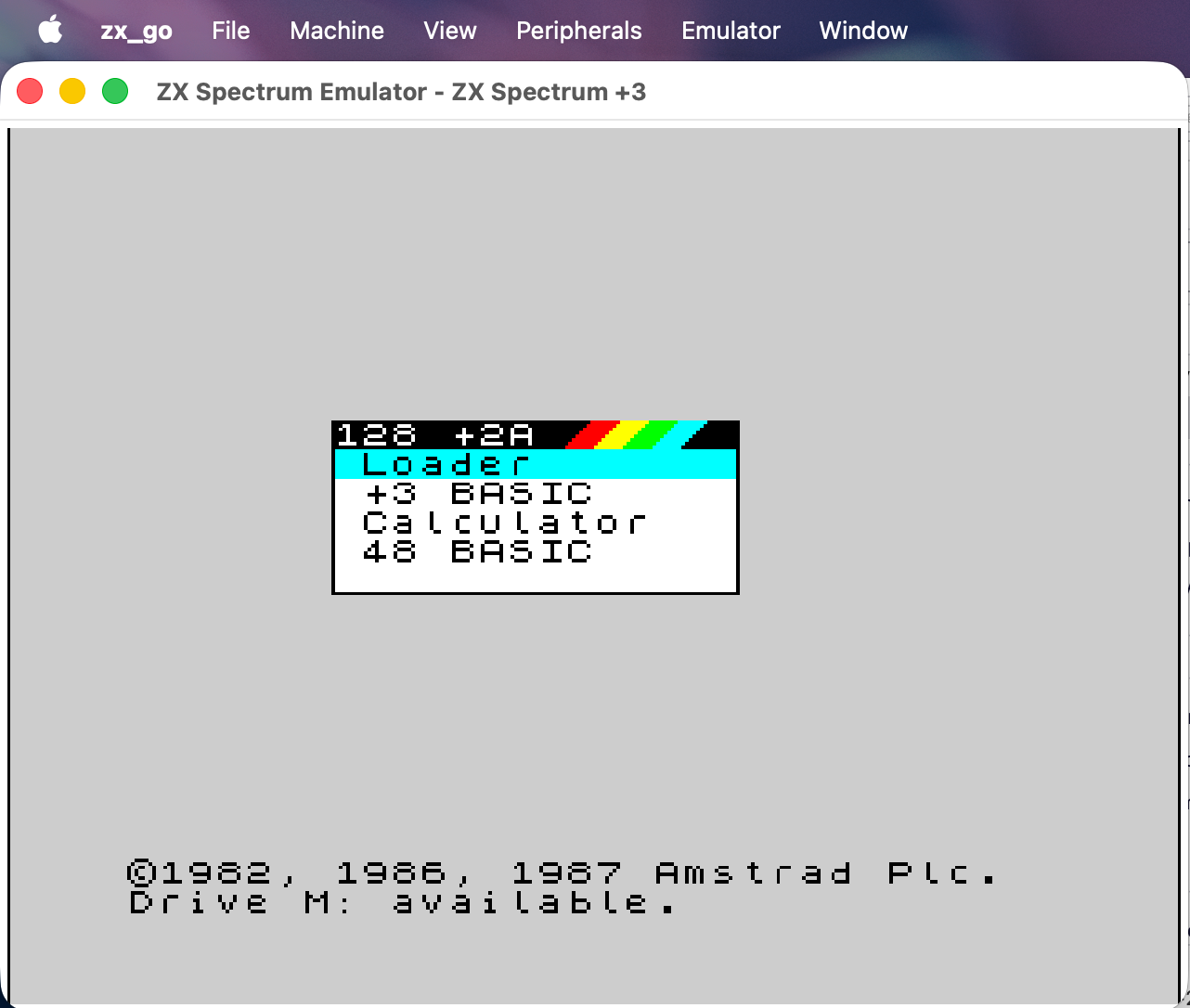
Authentic cold boot. ./bin/zxplay_go --next runs the genuine chain with no captured-state replay: FPGA bootrom splash → TBBLUE firmware → NextZXOS welcome → main menu. The Browser lists your SD card's C:/, NextBASIC runs interactively (type, RUN, BREAK), 128K BASIC opens the real Sinclair "128" menu pixel-for-pixel, and pressing SPACE at the splash gives the firmware config menu that boots any machine personality.
The full custom hardware:
- Layer 2 — 256×192 plus the 320×256 / 640×256 hi-res modes, per-pixel priority, hardware scrolling, 256-colour and 9-bit (4096-colour) palettes.
- 128 hardware sprites — 4bpp & 8bpp, scaling, mirror/rotate, relative/anchor groups,
$303Bcollision detection. - Tilemap + Copper — 40×32 / 80×32 tilemap with text mode and per-tile scroll/clip/mirror/rotate; a raster-precise Copper co-processor.
- The full NextReg file (audited against the FPGA core) + the 8K MMU and all four clocks (3.5 / 7 / 14 / 28 MHz) with contention scaling.
- Storage — DivMMC + esxDOS, SD-card / FAT image or a host-folder mount, plus zxnDMA, UART, Multiface 3, and a battery-backed i2c RTC.
.NEXgames load through NextZXOS's own loader fromFile → Open File…. Compatibility is young: some titles (e.g. Sonic) are playable, others render with bugs, and many are unverified — see the status note and the compatibility manifest.
Setup
The classic modes need nothing — their ROMs are embedded. The Next needs two licensed ROMs (enNextZX.rom, enNxtmmc.rom) that can't be bundled, plus SD-card content.
The easy way: pick Machine → ZX Spectrum Next. If the ROMs aren't installed, zxplay_go offers to download them for you from the official Spectrum Next distribution, installs the SD content, and boots straight in. The GPLv3 FPGA loader (tbblue_loader.rom) ships embedded, so there's nothing else to fetch.
⚠️ Version match: install the Next ROMs from the same distro as your SD-card content — NextZXOS traps on a version mismatch. The install dialog cross-checks and warns you.
Manual install, pointing at an SD card or .img, persistence (--sd-writeback), and the full boot/troubleshooting story are in docs/spectrum-next.md.
Installation
Pre-built binaries
Grab the latest from the Releases page:
| Platform | Download |
|---|---|
| macOS (Apple Silicon) | zxplay_go-macos-arm64.tar.gz |
| macOS (Intel) | zxplay_go-macos-amd64.tar.gz |
| Windows | zxplay_go-windows-amd64.zip |
| Linux | zxplay_go-linux-amd64.tar.gz |
On macOS/Linux: tar xzf zxplay_go-macos-arm64.tar.gz && ./zxplay_go. On Windows: unzip and double-click zxplay_go.exe. The Linux tarball also carries the desktop integration (./install-desktop.sh ./zxplay_go sets up the menu entry and Spectrum file associations). Releases are cut from the zxcode monorepo, where this tree lives, by tagging zxplay_go-v<version>.
The classic ROMs (48K → +3, plus the DISCiPLE / Multiface / Interface 1 peripheral ROMs) are embedded in the binary — nothing to install for those modes.
Building from source
You need Go 1.25+, a C compiler (cc/gcc/clang — Fyne uses cgo), and OpenGL libraries (system-provided on macOS and most Linux; trivial on Windows).
git clone https://github.com/stever/zxcode
cd zxcode/packages/emulator-core/zxplay_go
go build -o bin/zxplay_go ./cmd/zxplay_go
./bin/zxplay_go

# Run the tests (~90s, forty-plus packages)
go test ./...
Using zxplay_go
Everything classic just works — pick a model from Machine, and load software from File → Open File…. For a guided tour of every day-to-day task — choosing a machine, loading tapes/snapshots/disks, quick save/load (F2/F4), peripherals, sound, the keyboard, and troubleshooting — read the user manual.
Keyboard, joystick & mouse (essentials)
| Spectrum | Host |
|---|---|
| CAPS SHIFT | Left Shift |
| SYMBOL SHIFT | Right Shift / Ctrl / Alt / ⌘ |
| Arrow keys | Arrows (CAPS SHIFT + 5/6/7/8) |
| DELETE | Backspace |
| BREAK | F11 |
| NMI / Multiface | F12 |
| Quick save / load | F2 / F4 |
Pick a joystick scheme from Peripherals → Joystick (Kempston, Sinclair left/right, Cursor/Protek); enable Peripherals → Kempston Mouse for mouse support. Keymaps are editable and persist in config.json. The full menu reference and key tables are in the manual.
Playing a joystick game (e.g. a Spectrum Next .nex such as Sonic): move with the arrow keys, fire/jump with Right‑Alt or Right‑Ctrl. The Next always has a built‑in Kempston joystick, so on the Next the arrow keys drive it out of the box — you don't need to pick a scheme. (A game's own title menu may use its own keys; once in‑game, the arrows + Right‑Alt are your controls.)
Debugging & headless tooling
zxplay_go ships three ways to inspect a running machine, all sharing one live backend — a breakpoint set over telnet fires in the GUI's gutter, and the register-watchpoint / time-travel / M1-history state is shared across all surfaces.
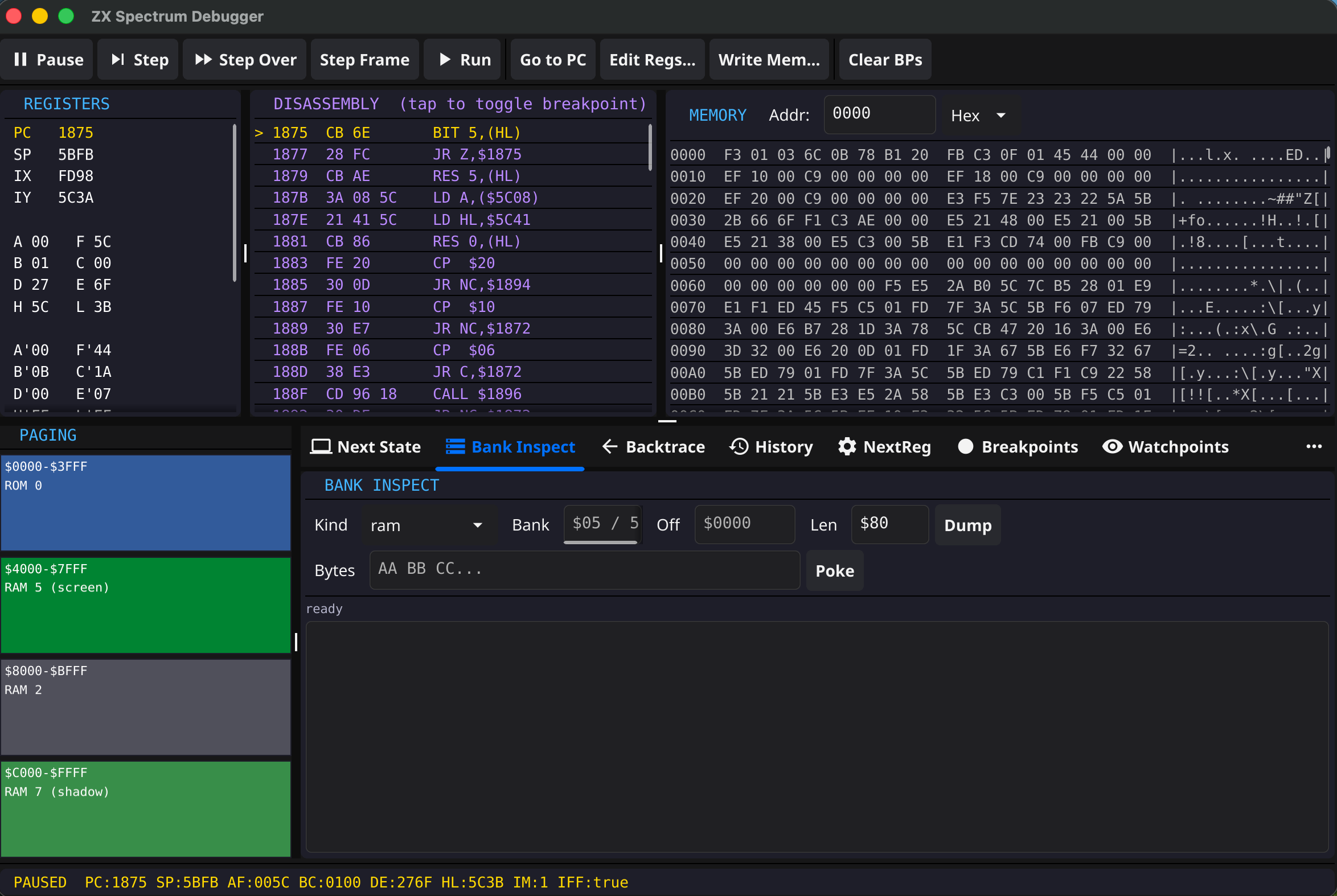
- Visual debugger (
Emulator → Debugger) — live registers, full Z80 + Z80N disassembly (click a line to toggle a breakpoint), 64 KB hex view, paging diagram, and tabbed tools: Next State, Bank Inspect, Backtrace, M1 history & heatmap, NextReg, conditional/bank-filtered breakpoints, register watchpoints, time-travel, and — on the Next — live Palette / Sprites / Layer 2 / Tilemap inspectors. - Telnet debugger — a ZRCP-style line server (
--debugger-port=N) you drive fromnc/telnet/ scripts. Bank-aware breakpoints, watchpoints, tracepoints, heatmaps, time-travel, provenance. - Headless instrumentation —
--headlesswith trace channels, periodic state snapshots, memory-write watchpoints, bank-switch / SD logging, PC triggers, and a loop/stall detector.
A few examples:
# Boot straight into a file — the extension picks the machine:
# .tap/.tzx auto-type LOAD, .nex boots the Next, .trd the Pentagon,
# snapshots restore their own model. Works headless too. An explicit
# model flag (--pentagon game.tap) beats the extension.
./bin/zxplay_go game.tap
./bin/zxplay_go --headless --frames=2500 --save-screen=/tmp/run.png game.nex

# File-manager double-click integration (per-user, Linux/XDG):
./desktop/install-desktop.sh   # see desktop/README.md

# Boot the Next headless and capture the framebuffer
./bin/zxplay_go --next --headless --frames=3000 --save-screen=/tmp/boot.png

# Mount and play a tape headless (then drive LOAD"" with --press-key, or use
# the 128 Tape Loader on a 128K model)
./bin/zxplay_go --headless --tape game.tap --frames=5000 --save-screen=/tmp/tape.png

# Open the scriptable telnet debugger, paused at reset
./bin/zxplay_go --next --headless --debugger-port=10000 --debugger-pause-at-start

# One-shot state dump (CPU + MMU + NextRegs + sysvars + screen) after 300 frames
./bin/zxplay_go --next --headless --dump-state=300
Every flag is in ./bin/zxplay_go --help. The complete debugger guide — every visual tool, the full telnet command reference, worked examples, and the headless diagnostics — is in DEBUGGER.md.
How it compares
Wondering how zxplay_go stacks up against CSpect, ZEsarUX, and MAME (tbblue)? COMPARISON.md has a fair, criterion-by-criterion table — licensing, platforms, Next hardware coverage, CPU/timing accuracy, media, peripherals, audio, and debugging — with sources and honest caveats about where zxplay_go is young and where the others lead.
Documentation
| Doc | What's in it |
|---|---|
| Architecture docs | Developer documentation: architecture, code organisation, implementation patterns, chip emulation, the Next FPGA internals, known gaps — with Draw.io diagrams. |
| User manual | Day-to-day use: machines, loading, saving, peripherals, sound, shortcuts, troubleshooting. |
| Spectrum Next | ROM install, SD-card setup, boot status, .NEX, licensing. |
| ZX80 / ZX81 | The CPU-generated-display machines in detail. |
| SAM Coupé | The MGT SAM Coupé: modes, sound, disk, status. |
| Debuggers | Full visual + telnet + headless reference. |
| Compatibility | The tested-title manifest and how class evidence works. |
| Comparison | vs. other Spectrum Next emulators. |
Project layout
cmd/zxplay_go/        GUI (Fyne) + headless CLI entry point
pkg/
  z80/            Z80 + Z80N CPU core
  ula/            Display, border, audio, tape I/O, port dispatch
  memory/         Bank paging, contention, FPGA bootrom
  keyboard/  audio/  ay/         Input + beeper + AY sound
  snapshot/  rzx/                SNA/Z80/SZX + RZX recording
  plus3fdc/  microdrive/  if1/  if2/   Disk, microdrive, interfaces
  kempmouse/  zxprinter/          Mouse + printer
  peripherals/  disciple/  multiface/  Peripheral manager + devices
  next/           Spectrum Next: nextregs, divmmc, esxdos, sdcard,
                  layer2, palette, sprite, copper, dma, dac, rtc,
                  uart, nex, compositor, install
  debugger/       Visual debugger backend
  testharness/    Headless scripted emulator (40+ integration tests)
  roms/  config/  trace/  zxlog/   ROMs, settings, tracing, logging
docs/             Per-subsystem documentation
LICENSES/         GPLv3 text + NOTICE for the embedded tbblue_loader.rom
License
GPLv3 as a whole — see LICENSE. Upstream zx_go is MIT; the modifications and additions made in this repository are GPLv3, so this modified tree is distributed under GPLv3. The bundled FPGA loader (pkg/roms/data/tbblue_loader.rom, embedded) is also GPLv3; see LICENSES/tbblue_loader-NOTICE.md. The NextZXOS system ROMs are licensed (Amstrad/Sky) and are not bundled — they're downloaded on first run.